- Home
- Citations and References
- The Jurisprudence Gap
- Law and Corrections
- Governance and Operation
- Public Safety Crisis
- Coverage and Lawful Duty
- Admin Operations Manual
- The Staffing Record
- Oversight of Codified Law
- Public Safety Efficacy
- Budgetary Gap Analysis
- Correctional Staffing
- Workforce Engineering
- Areas of Expertise
- Critical Technology
- Contact Us
Relief Factors, Coverage, and Lawful Duty
The factor measures hours required to stand the post. The duty is in the governing instrument.
A relief factor is the multiplier that turns one authorized post into the FTE required to keep that post covered across the year. A post that must run twenty-four hours a day, seven days a week, cannot be filled by a single officer. Days off, leave, training, and other time away from the post consume available hours. The relief factor measures that time away and states how many full-time equivalents are required so the post remains staffed when those hours are lost.
That figure is not optional arithmetic. It is the bridge between the plot plan, the table of organization, and the roster. If the factor is stale or static—or not applied by institution—the authorized post exists on paper while coverage is supplied by overtime, by a closed post, or not at all. If the factor is studied, validated, and applied to primary and ancillary posts, required work can be expressed as funded FTE, posted coverage, and overtime used only as substitute hours—not as the plan.
Every correctional system that runs fixed posts uses some version of this measure, whether it is named a relief factor, a full-coverage factor, or a net-availability rate. The work is the same: time on post and time away from post, reduced to FTE, then compared with the bodies on the books. The factor must be recalculated when leave patterns, tour length, training demand, or the post mix change. A 2006 number cannot staff a 2024 institution.
The document that follows is Virginia’s 2024 security-staffing assessment and relief-factor recalculation (RD928), prepared after the last formal statewide calculation in 2006 produced an average of 5.13 FTE per 24/7 security post. Virginia’s report records a higher 2024 factor and filled staff below authorized levels. Those are the Department’s and CGL’s findings. They illustrate why a stale or static factor cannot account for coverage. They are not a staffing order for any other system. Other systems remain governed by their own statute, regulation, order, and facts. The universal requirement is the same: the relief factor must be studied, managed, and applied, or the staffing record cannot account for coverage.
RD928 - Virginia Department of Corrections Security Staff Assessment and Relief Factor Recalculation
Published: 2024
Author: Virginia Department of Corrections
Enabling Authority: Appropriation Act - Item 390 T. (Special Session I, 2024) - which includes provisions for relief factor calculation and security staffing.
Executive Summary:
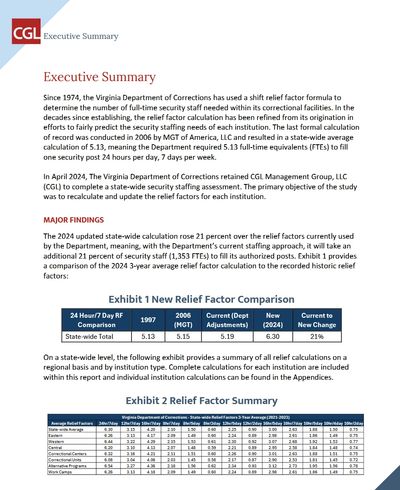
Since 1974, the Virginia Department of Corrections has utilized a shift-relief factor formula to determine the necessary number of full-time security staff for its correctional facilities. Over the decades, the relief factor calculation has been refined from its initial implementation to more accurately predict the security staffing needs of each institution. The last formal calculation on record was conducted in 2006 by MGT of America, LLC, resulting in a statewide average of 5.13. This means that the Department required 5.13 full-time equivalents (FTEs) to adequately fill one security post 24 hours a day, 7 days a week. In April 2024, the Virginia Department of Corrections engaged CGL Management Group, LLC (CGL) to perform a comprehensive state-wide security staffing assessment. The main goal of this study was to recalculate and update the relief factors for each institution.
MAJOR FINDINGS
The 2024 updated state-wide relief factor calculation indicates a 21 percent increase over the relief factors currently utilized by the Virginia Department of Corrections. This means that, with the Department’s existing security staffing approach, it will require an additional 21 percent of security personnel (1,353 FTEs) to adequately fill its authorized posts. Exhibit 1 (see page 5 of the report) compares the 2024 three-year average relief factor calculation with the recorded historic relief factors.
On a state-wide level, Exhibit 2 (see page 5 of the report) summarizes all relief calculations based on region and institution type. Complete calculations for each institution are provided within this report, and individual institution calculations can be found in the Appendices.
The remainder of this study includes CGL’s assessment of current security staffing within the Virginia Department of Corrections’ institutions and offers recommendations to mitigate the staffing needs identified in the updated relief factor calculations. CGL was contracted to visit at least 20 percent of its correctional centers and field units to observe security staffing practices and offer recommendations that could assist the Department in identifying opportunities for change. CGL was tasked with providing a comparative assessment based on its experience with staffing models in other state prison systems, evaluating how the Virginia DOC manages security staffing and pinpointing areas for improvement. There is limited variation in the different staffing models observed in prison settings. Within this assessment, CGL analyzed three staffing models and complemented this analysis with comparative approaches and benchmarking against other prison systems, including the practices and benchmarks from:
• Pennsylvania DOC
• Washington DOC
• Iowa DOC
• Minnesota DOC
• Ohio DOC
• South Dakota
• New Jersey Women’s Prison
Chapter 6 – Conclusions and Recommendations provides a comprehensive summary and list of findings and recommendations. Below is a summary of our major findings.
Security staffing within the state correctional system has undergone significant changes over the past couple of decades. Previously, security officers were assigned to indirect supervision housing facilities, with one officer stationed in a control center and another (or two) assigned to tour through housing units periodically to conduct counts, wellness checks, perform security integrity inspections, and ensure the safety of those residing in the housing units. As the industry evolves, it is becoming increasingly vital for officers to maintain more contact and longer presence in housing units to deter negative behavior. With the implementation of direct supervision philosophies, a greater number of officers are needed in staffing allotments to ensure continuous supervision in housing units. Officer roles have expanded to include counseling and involvement in individual programming needs. Additionally, with the growing special-needs population requiring extra attention, extensive medical care, and increased supervision, the need for corrections officers is rising. Maintaining adequate security staffing within an institution is no longer a straightforward task, and finding the right staff for the right environment is becoming increasingly challenging.
The Virginia Department of Corrections is currently funded for a level of security staff to support its operations and fill the identified posts on each facility’s Post Audit. However, over the last decade, the Department has only managed to maintain an average of 84 percent of its security staff.
The Virginia DOC is critically, and in many cases dangerously, short-staffed—not due to financial constraints, but due to the inability to hire, train, and retain sufficient staff to fill positions within the institution. This lack of security staffing affects every aspect of facility operations, resulting in environments that are both unsafe and inefficient.
• Low staffing levels are causing existing staff to work excessive hours, leading to lower morale and increased burnout. Without intervention, the Department will continue to struggle with staff turnover.
• Non-security staff are performing duties typically reserved for corrections officers.
• Supervisory staff, up to the captain level, are taking on line officer responsibilities.
• Post Audits have not been consistently updated to reflect low staffing levels, effectively invalidating the security staffing plans.
• Some housing units are operating without proper supervision.
• High levels of external transportation are straining facility staffing levels.
• There are unconventional posts that are not commonly observed in state prison systems.
• Duplicative roles exist within supervisor/management positions.
• Security has been compromised due to insufficient staffing.
• Differences in management philosophy, such as direct versus indirect supervision, are impacting operations.
• A higher-than-average number of new officer training hours is driving up relief factors, combined with a high number of new hires.
• Although the Staffing Committee has conducted Post Audit assessments every two years and identified staffing needs, the DOC has often faced challenges in securing additional staffing.
Despite being dangerously short-staffed in some facilities, the staff and leadership of the Virginia Department of Corrections have excelled in maintaining safety and security, particularly in light of the increasing number of violent offenders and individuals with behavioral disorders observed throughout the industry.
RECOMMENDATIONS TO LOWER THE RELIEF FACTOR CALCULATION
There are a few ways to reduce the identified FTE need in Virginia, but each will take time to realize the impact after implementation.
• Reduce the new hire training hours – work with the Virginia Department of Corrections to minimize the wait time between Phase 2 and Phase 3. For our calculations, we estimated a delay of 200 hours before a new hire receives a seat in the academy. This estimate is generously low, given feedback from wardens showing some wait times up to 400 hours. Reducing this wait time would decrease the overall training hours used in the relief factor calculation.
• Move portions of the Field Training Program earlier – Some state prisons have achieved minor improvements by advancing the Field Training Program, or the control room and report writing portions, to occur before attendance at the academy. If wait times between Phase 2 and Phase 3 cannot be reduced, moving portions of the Field Training Program earlier could lower total training hours and subsequently reduce the training hours factored into the relief factor calculation.
• Similarly, if the Department chose to hire non-security personnel to fill current security positions, as suggested above, and these individuals became candidates for correctional officer roles, a portion of the Field Training Program could already be completed during non-security new hire training, further reducing hours from Phase 4.
• Revisit and update all Post Audits – the Virginia Post Audits have been in place for many years, receiving amendments upon request from wardens or based on Department initiatives. CGL recommends a complete overhaul of Post Audits to re-establish necessary security posts. Throughout the remainder of this study, we make several recommendations to reconsider existing posts and the level of employee required. Realigning Post Audits to meet current needs in the Virginia Department of Corrections would effectively reduce the number of FTEs required.
• Reducing vacancies throughout the state – vacancies are a challenge in most state prison systems. The answer to filling vacancies is complex as it requires understanding the reasons behind them. Some reasons identified in Virginia include salaries compared to surrounding employment opportunities (other correctional agencies at the county and federal levels), work environment compared to jobs outside of corrections, staff retention issues, facility cultures, and the individual employment priorities of new hires.
• CGL recommends a state-wide study of external transportation needs and the development of a Centralized Transportation Unit to lessen the burden on individual facilities.
• In exploring methods to minimize transportation, CGL suggests the Department explore opportunities to repurpose existing or closed facilities to create a centralized special needs institution, which will impact the volume of external transportation activity.
• CGL recommends a state-wide study of the implementation and use of Unit Management to align it with industry practices that support a unified facility culture. Within this recommendation, we suggest evaluating the need for two managers who might have conflicting roles in unifying staff within a building.
The following is a list of CGL’s recommendations to consider replacing current security posts with non-security employees to alleviate pressure on security staffing:
• Investigations and Intelligence Posts – in many facilities, we observed ranking staff dedicated to an investigations office, staffed with multiple supervisors and officers. While security staff are essential to these posts, other DOC systems have assigned non-security analysts to handle administrative functions such as pulling videos, listening to telephones, monitoring video visitation, and reading emails, which enables security staff to focus on conducting investigations. Facilities staffed solely with security personnel often spend excessive amounts of time managing administrative tasks. Additionally, the ranking staff (captains and lieutenants) are generally responsible for the unit but are not directly involved in the day-to-day processing and investigation of information.
• Property Units – in several facilities, we observed sergeants and officers assigned to manage inmate property. As mentioned earlier, many DOCs have delegated this responsibility to non-security staff or third-party vendors.
• Laundry Units - in several facilities, we observed sergeants and officers assigned to handle inmate laundry. Again, many DOCs have assigned this responsibility to non-security staff or third-party vendors.
• Control Room Gun Posts – in higher custody facilities, we observed a second corrections officer assigned to control rooms, designated as the “Gun Post.
SAFE POPULATION LEVELS
With the newly calculated relief factor calculations and updated security staffing levels, CGL was tasked with determining the safe population levels of each institution, taking into account different correctional officer staffing levels of 100 percent, 75 percent, 50 percent, and 35 percent. The authorized staffing level for each institution’s security Post Audit, as outlined by the Virginia Department of Corrections, is based upon the full bed capacity of the facility. To calculate the safe population levels for each staffing scenario, CGL computed a staff-to-inmate ratio using the authorized staffing levels and provided our methodology for these calculations. Exhibit 3 illustrates CGL’s calculation for safe population levels of each institution.